Contact us for information on hire purchase and leasing options!
Manufacturer description
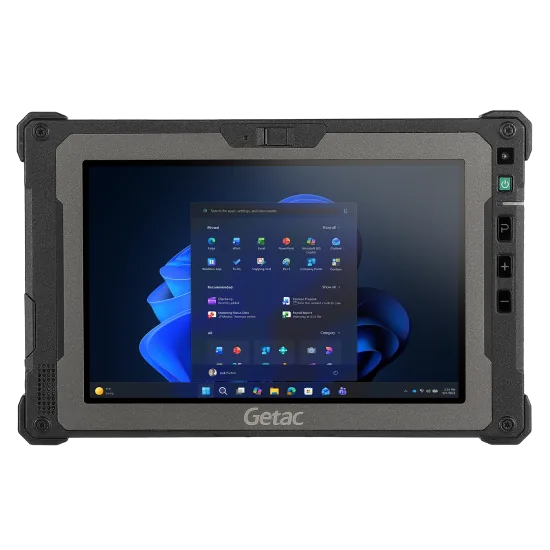
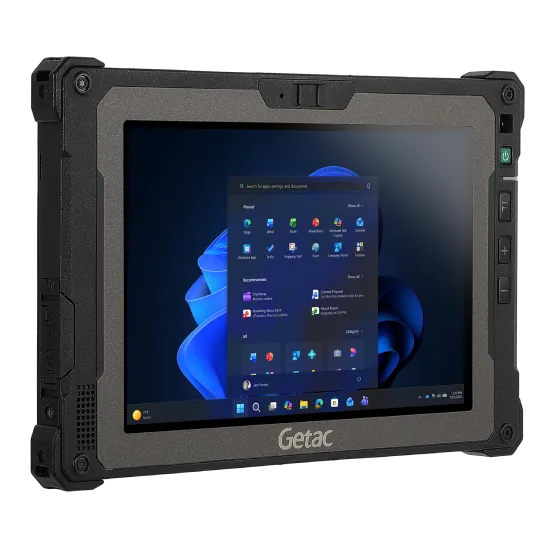
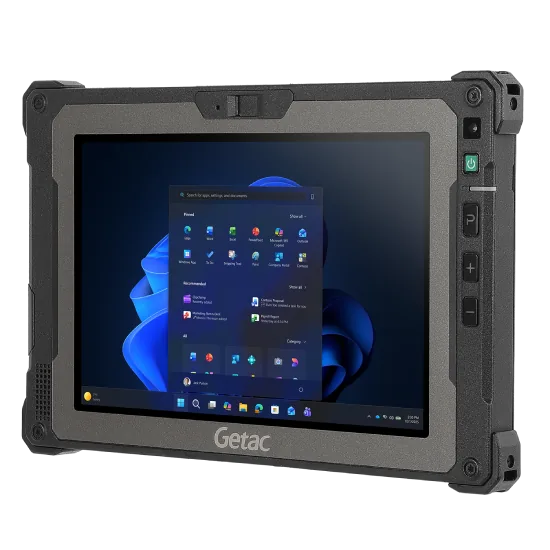
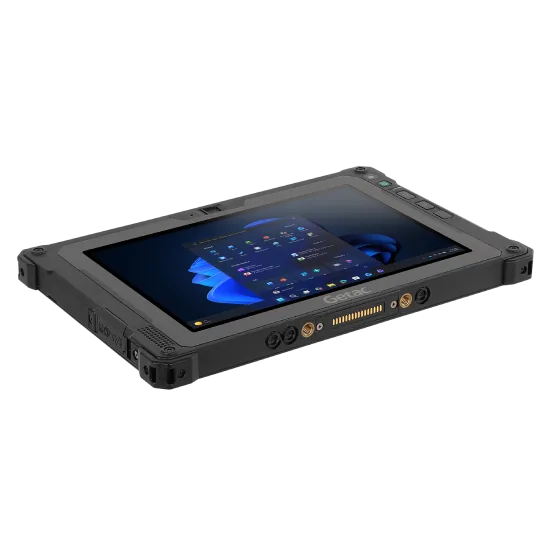
The Getac ZX80W is a fully rugged 8-inch tablet running Windows 11 IoT Enterprise LTSC on a Qualcomm QCS6490. The figures below are taken from the manufacturer datasheet (Getac, as at 12 August 2026, German and English versions).
Display: 8-inch wide-viewing-angle TFT LCD, WUXGA (1920 x 1200), 1000 nits (LumiBond display with Getac sunlight readable technology), capacitive multi-touch screen, glove-capable; dual mode touchscreen (multi-touch and digitizer) optional.
Processor: Qualcomm QCS6490, octa-core 1.9 GHz (max. 2.7 GHz); Qualcomm Adreno 643 GPU; Qualcomm Hexagon NPU with up to 13 TOPS (6th-generation Qualcomm AI Engine).
Interfaces: 1× USB 3.2 Gen 1 Type-C (with DisplayPort and Power Delivery), audio combo jack, MicroSD, docking connector; 8 MP webcam and 16 MP autofocus rear camera; optional SIM card slot or hybrid SIM tray, RF antenna pass-through and 1D/2D imager barcode reader.
Wireless and positioning: Wi-Fi 6E (802.11ax), Bluetooth 5.2, dedicated L1/L5 GPS; optional 4G LTE, 5G Sub-6 and dual SIM (Nano-SIM 4FF and eSIM).
Ruggedness:IP67, MIL-STD-810H, vibration resistant, drop resistant up to 1.8 m (6 ft); operating temperature -29 °C to 63 °C; optional ANSI/UL 121201 and CSA C22.2 NO. 213 (Class I, Division 2, Groups A, B, C, D). Dimensions 234 × 149.8 × 17.6 mm, weight 590 g.
Power: internal battery 3.86 V, typical 4060 mAh; swappable batteries with LifeSupport technology, options with typical 4990 mAh or 9980 mAh (3.84 V).
Software: Windows 11 IoT Enterprise LTSC; pre-installed Getac Utility and Getac KeyWedge Barcode Reader Utility (trial version); optional Getac Monitoring.
Accessories: vehicle dock, office dock, vehicle cradle, multi-bay chargers (two or eight bays), styluses, hand straps and shoulder strap; 3 years Bumper-to-Bumper as standard.
Positioning
In its press release of 3 June 2026, Getac presents the ZX80W as a fanless Windows 11 tablet on Arm architecture and describes it as an extension of the ZX80 range. On its product page Getac names defence, utilities, and transport and logistics as fields of use, including drone control (UAV), electronic logging devices (ELD), meter reading, mobile GIS, surveying and fleet management.
The closest relative of the ZX80W is the Android sister model Getac ZX80. Both datasheets list the same Qualcomm QCS6490, 12 GB LPDDR5 and 256 GB UFS, an 8-inch display with 1920 x 1200 pixels and 1000 nits, IP67, MIL-STD-810H, 590 g, an operating temperature range of -29 °C to 63 °C, Wi-Fi 6E, Bluetooth 5.2 and the same battery options (internal 4060 mAh, swappable 4990 or 9980 mAh). The documented main difference is the operating system: Windows 11 IoT Enterprise LTSC on the ZX80W, Android 15.0 on the ZX80 (datasheet dated 06 August 2026). In addition, the ZX80W lists the L1/L5 GPS without the word “optional” that the ZX80 datasheet carries, and names fTPM (Qualcomm TrustZone) and Getac Secure Erase as security features. NFC appears in the ZX80 datasheet as an option but is missing from the ZX80W datasheet, so whether the ZX80W offers NFC remains open.
What the datasheet leaves open: it gives neither a battery runtime nor the release of the Windows version, and according to its footnotes weight, dimensions and drop test results depend on the configuration and accessories. The press release names Arm architecture as the platform. Whether an existing Windows application and its drivers run on it is not stated in the datasheet and has to be tested on a pilot unit (background in our article Getac ZX80W: Windows 11 on Arm). If you mainly run Android apps, the ZX80 is the better fit, more under Windows or Android on a rugged tablet. For hazardous areas (ATEX/IECEx Zone 2/22) the press release names a separate variant, the ZX80W-EX; the ZX80W itself lists only the optional approval to ANSI/UL 121201 and CSA C22.2 NO. 213 (Class I, Division 2).
Ruggedness and standards
The datasheet names MIL-STD-810H, the protection rating IP67, and resistance to vibration and to drops of up to 1.8 m (6 ft). Under IEC 60529, IP67 stands for dust-tight and protected against temporary immersion; background in the article IP67 in detail. According to a footnote, drop test results vary with the configuration and optional accessories. What stands behind the MIL-STD-810 test methods is explained in MIL-STD-810 for laptops and tablets.
The datasheet gives an operating temperature of -29 °C to 63 °C (-20 °F to 145 °F), a storage temperature of -51 °C to 71 °C (-60 °F to 160 °F) and 95% relative humidity, non-condensing. According to a footnote, the temperature figures were tested by an independent test laboratory following MIL-STD-810H. ANSI/UL 121201 with CSA C22.2 NO. 213 (Class I, Division 2, Groups A, B, C, D) is listed as an option, and according to a footnote only with limited configurations and environment conditions. The datasheet gives no ATEX marking for the ZX80W. The device weighs 590 g at 234 × 149.8 × 17.6 mm; according to a footnote, weight and dimensions vary with the configuration and accessories.
Display and readability
The display measures 8 inch (TFT LCD with wide viewing angle) and resolves WUXGA 1920 x 1200 pixels in 16:10 format. Brightness is given as 1000 nits, as a LumiBond display with Getac sunlight readable technology. The touchscreen is capacitive multi-touch and, according to the datasheet, glove-capable; a dual mode touchscreen with digitizer for pen input is optional. The datasheet lists a protection film both under display and under accessories.
The datasheet gives neither contrast nor anti-glare treatment. How much brightness is needed outdoors depends on the surroundings and the surface; background in the article sunlight readable displays. For comparison: the T800 and the N80G2 in the table below give 600 nits and 500 nits.
Interfaces and expansion
The datasheet lists the following interfaces on the tablet. We reproduce the list as given there, because build levels can differ:
1× USB 3.2 Gen 1 Type-C (with DisplayPort and Power Delivery)
1× audio combo jack
1× MicroSD (or optionally a hybrid SIM tray, Nano-SIM 4FF, with MicroSD)
1× docking connector
8 MP webcam and 16 MP autofocus rear camera
optional SIM card slot (Nano-SIM, 4FF)
optional RF antenna pass-through for GPS, WWAN and WLAN
optional 1D/2D imager barcode reader in the expansion slot
The datasheet does not mention Thunderbolt; the only USB port on the tablet is USB 3.2 Gen 1 Type-C with DisplayPort and Power Delivery. Serial port, LAN and HDMI appear only in the dock table: the vehicle dock has 1× serial, 1× DC in, 2× USB 2.0, 1× LAN and 3 RF antenna connectors (WWAN, WLAN, GPS); the office dock has 1× audio combo jack, 2× USB 2.0, 1× USB Type-C (PD only), 1× LAN, 1× HDMI and 1× Kensington lock. According to the English version of the datasheet, units with the 4G/5G option come with an embedded SIM card slot.
Power and battery
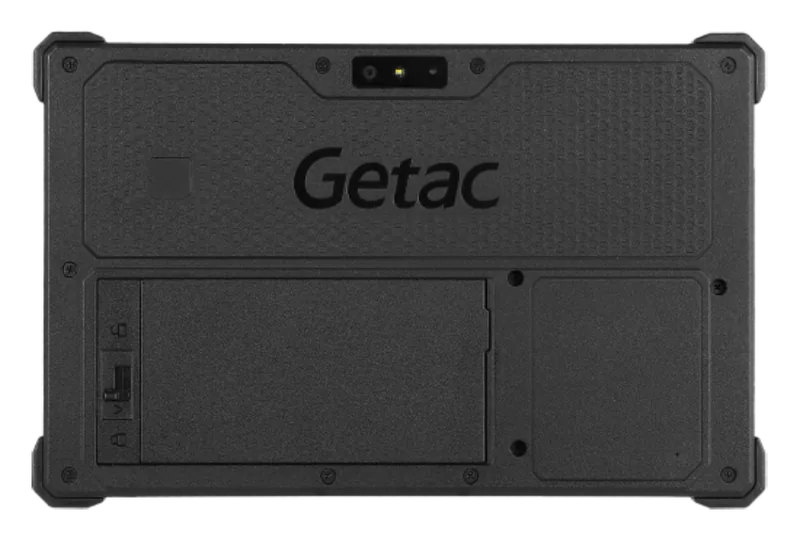
The ZX80W has an internal battery of 3.86 V and typically 4060 mAh (minimum 3950 mAh). It is complemented by LifeSupport technology for swappable batteries; in its summary Getac describes them as hot-swappable. As standard the battery bay carries a cover; as options there is a battery of 3.84 V and typically 4990 mAh (minimum 4870 mAh) or a high-capacity Li-ion battery of 3.84 V and typically 9980 mAh (minimum 9470 mAh). Calculated as nominal voltage × typical capacity, that is roughly 15.7 Wh internal and 19.2 Wh and 38.3 Wh for the swappable batteries.
The datasheet gives no runtime; the press release speaks of all-day battery life without stating test conditions. As accessories the datasheet lists a 65 W USB-C AC adapter, a DC-DC vehicle adapter (65 W, 12-32 VDC) and multi-bay chargers for two or eight bays. Background on swappable batteries: Swappable batteries and hot-swap.
Wireless and positioning
As standard the datasheet lists Wi-Fi 6E (802.11ax), Bluetooth 5.2 and a dedicated L1/L5 GPS that, according to a footnote, supports GPS, GLONASS, Galileo and BeiDou. Cellular is optional: 4G LTE, 5G Sub-6 and dual SIM (Nano-SIM 4FF and eSIM); this comes with one physical SIM slot and one eSIM, and network service may vary by provider. According to a footnote, Bluetooth performance and range can be reduced by interference in the environment. The datasheet does not state supported frequency bands.
Security
The datasheet names fTPM (Qualcomm TrustZone) and Getac Secure Erase as security features. It does not list a fingerprint, smart card or face reader. The summary mentions enterprise-level management tools without naming them.
Software
The operating system is given as Windows 11 IoT Enterprise LTSC; the datasheet does not say which release is shipped. According to the datasheet, Getac Utility and a trial version of the Getac KeyWedge Barcode Reader Utility are pre-installed; Getac Monitoring and the Getac KeyWedge Barcode Reader Utility are optional. What LTSC means for support and feature scope is covered in the article Windows 11 IoT Enterprise LTSC for rugged devices.
Accessories according to the manufacturer
The datasheet lists the following optional accessories:
Carry bag
Battery (3.84 V, typical 4990 mAh; min. 4870 mAh)
High capacity Li-ion battery (3.84 V, typical 9980 mAh; min. 9470 mAh)
DC-DC vehicle adapter (65 W, 12-32 VDC)
Multi-bay charger (two bays)
Multi-bay charger (eight bays)
Digitizer pen
Capacitive stylus with tether
Protection film
Hand strap with stylus holder
Rotating hand strap with kickstand
Shoulder strap (2-point)
Vehicle cradle
Vehicle dock
Office dock
65 W USB-C AC adapter
As standard the datasheet names a 3-year Bumper-to-Bumper warranty, which according to Getac includes accidental damage. According to the English version of the datasheet, the Gamber-Johnson vehicle dock and cradle are e-mark certified.
Common questions
How heavy is the Getac ZX80W?
590 g at 234 × 149.8 × 17.6 mm. According to a footnote, weight and dimensions vary with the configuration and optional accessories.
What protection rating does the ZX80W have?
IP67, plus MIL-STD-810H, vibration resistant and drop resistant up to 1.8 m (6 ft). The datasheet gives no ATEX marking.
Does the ZX80W run Windows or Android?
Windows 11 IoT Enterprise LTSC on a Qualcomm QCS6490. The Android variant of this platform is the ZX80. Whether a specific Windows application runs on the Arm architecture is not stated in the datasheet.
Does the ZX80W have cellular and GPS?
A dedicated L1/L5 GPS is part of the standard equipment. 4G LTE, 5G Sub-6 and dual SIM are optional.
Is the battery swappable?
Yes. Besides the internal battery (typically 4060 mAh) the datasheet lists swappable batteries of typically 4990 mAh and 9980 mAh; as standard a cover sits in the battery bay. It gives no runtime.
Compared with the Getac T800 (according to its datasheet with Windows 10 Pro and Intel Atom x7-Z8750; Getac has removed the document from its own range), the ZX80W offers more resolution, brightness and protection at 290 g less weight. The T800 additionally lists MIL-STD-461G, which is not listed for the ZX80W. The Fieldbook N80G2 is also an 8-inch device with Android 12 and IP67; its datasheet row gives 1280 x 800 pixels, 500 nits and no MIL-STD entry. More tablets are in the comparison table for tablets.
Image gallery
Swipe sideways to see all images.
Configure your device
Select the desired features. You can then transfer your configuration to your quote request – we will discuss pricing with you personally there.
Your configuration
This overview is a summary of your selection, not a verified configuration – we will confirm technical feasibility (especially for mutually exclusive options) bindingly in the quote.