A drone controller with a display combines sticks, switches and a screen for video, telemetry and map in one device. In professional use the same questions come up as for any field device: can you read the display in sunlight, does the housing withstand rain and dust, and does the device start in the cold? This article compares two devices from the RobustBook range that are built for this job. The RuggON Spark 7 GSS RTK is an Android handheld with joysticks. The Durabook GC-R8 is a control panel into which the Durabook R8 tablet is inserted. All device values come from the manufacturer datasheets and the RobustBook product pages. Information on controllers from other manufacturers comes from their own websites and serves only as a reference point. Neither datasheet names a drone that either device controls. You clarify that before buying, and this article shows which questions belong to it.
Drone controllers and ground control stations: what the device does
A controller has three jobs. It sends control commands to the drone, receives video and telemetry, and displays both. On controllers for everyday use, sticks and screen sit in one housing. In professional use the device is often called a ground control station. RuggON calls the Spark 7 a “Ground Control System” in its datasheet, and Durabook describes the GC-R8 as a “Bodenkontrollstation” (ground control station).
For telemetry, the Spark 7 datasheet lists the MAVLink protocol. According to mavlink.io, MAVLink is a very lightweight messaging protocol for communicating with drones and between their onboard components. The project page names drones, ground control stations and other MAVLink systems as participants that exchange data over it.
Two controllers from DJI, which RobustBook does not sell, serve as a reference for the order of magnitude. According to the DJI specification page, the DJI RC has a 5.5-inch display with 1920×1080 pixels and 700 nits, an operating temperature range of -10 °C to 40 °C and an operating time of 4 hours. According to the DJI Store, the DJI RC Plus 2 Enterprise Enhanced has a “High-bright display” with no nit figure, IP54 ingress protection, an operating temperature range of -20 °C to 50 °C and a lithium-ion battery of 6500 mAh at 7.2 V. These numbers are the yardstick for the values of the two devices below.
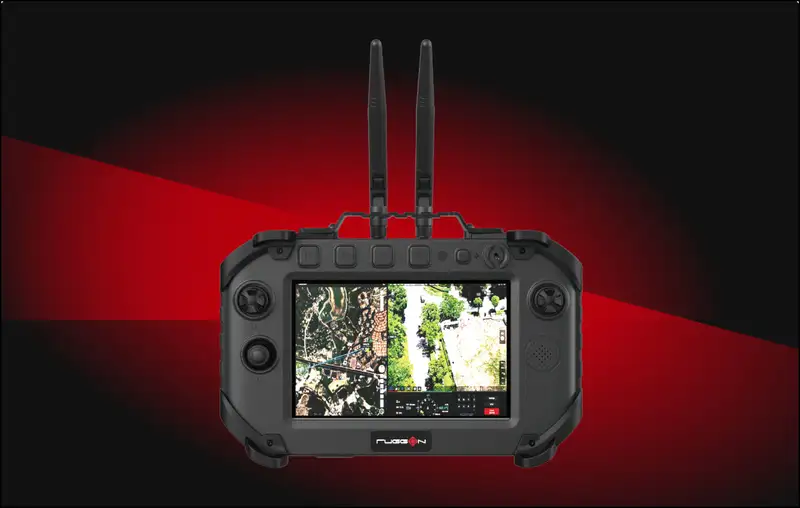
RuggON Spark 7 GSS RTK: Android handheld with joysticks
On the Spark 7, screen, controls and radio module sit in one housing. The datasheet (RuggON, dated 08.01.2026) lists a 7-inch display with 1080p and 1680 nits, sunlight readable and with touch. The processor is the Qualcomm Dragonwing QCS6490, together with 8 GB of RAM and 128 GB of storage, expandable by MicroSD. The operating system is Android 14, and the datasheet calls the control software “Flight Controller APP in Android”.
The controls are two joysticks, one gimbal joystick (shutter), one toggle switch, four function buttons, two thumbwheels and a power button. The radio module is a MIMO module with two to four antennas. The datasheet lists the frequencies 1.6 GHz, 2.4 GHz and 5.8 GHz, the transmit powers 0.2 W, 0.25 W, 1 W and 2 W, and a range of 2 km to 150 km, each depending on the radio module fitted. Remote control runs over USB and S.BUS/i.Bus, telemetry over MAVLink, video over RTSP. Point-to-point and point-to-multipoint connections are possible. AES encryption with 128 bit or 256 bit is an option.
The housing is designed to IP65 and MIL-STD-810H, and the operating temperature range runs from -20 °C to 50 °C. The dimensions are 263.8 × 166.9 × 68.4 mm; the datasheet gives no weight. A handle, a non-slip surface and a tripod thread belong to the design. Power comes from a battery that can be swapped during operation (capacity not stated) or from a power supply with 65 W at 20 V. The ports are USB-C (USB 3.1, DisplayPort), USB 2.0 and RJ45, with an optional Nett Warrior interface. For data connectivity the datasheet lists Ethernet and Wi-Fi 6E.
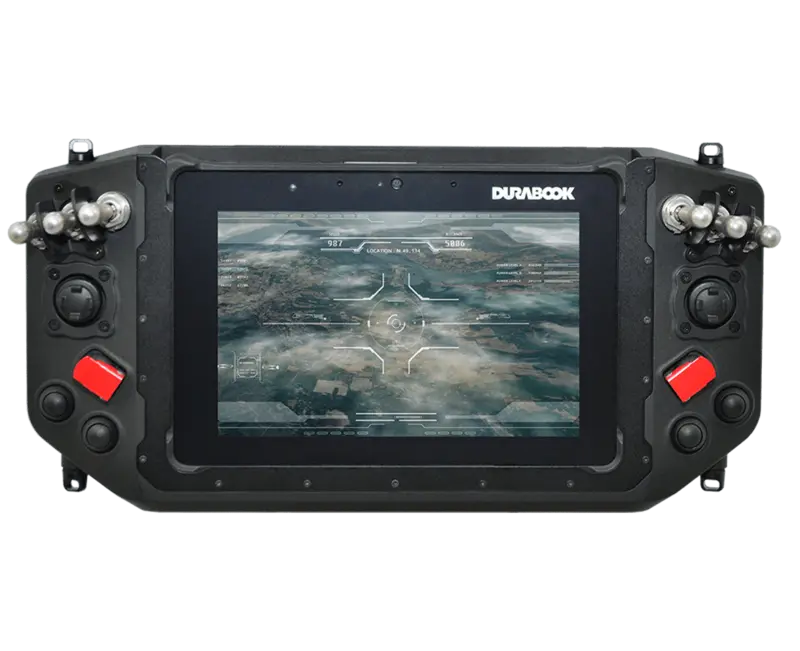
Durabook GC-R8: control panel for the R8 tablet
The GC-R8 has neither its own screen nor its own battery. It is a control panel with an STM32L-series microcontroller, into which the Durabook R8 tablet is inserted. Display, processing power and power (19 V DC) come from the tablet. The datasheet (Durabook, dated 22.09.2025) lists one Hall-effect joystick per side, on the left optionally a control pad, plus one push button with a flip guard, two push buttons and one push button on the back. Optional on each side are three toggle switches with protective barriers and a thumbwheel on the back.
The ports are M12 military connectors for DC power, LAN (RJ-45 10/100/1000) and USB 2.0. Optionally, two antenna ports each for WLAN and for WWAN are added. For mounting, the datasheet lists the VESA hole pattern 75 mm and 100 mm as well as holes for a stylus holder. Listed accessories are shoulder straps with two or four points, D-ring screws and a stylus. The GC-R8 is designed to IP66 and MIL-STD-810H. The operating temperature is -20 °C to 60 °C, the storage temperature -51 °C to 71 °C, and the humidity 5 % to 95 %. The dimensions are 365 × 180 × 69.9 mm, and the weight is under 1.2 kg and varies with the configuration. The datasheet does not say whether the tablet is included in this figure.
The tablet brings an 8.0-inch display with 1280 × 800 pixels and 800 nits, an Intel Core i5-1230U with vPro or an Intel Pentium Gold 8500, and a weight of 0.86 kg. It runs Windows 11 Professional, has a swappable battery of 3600 mAh and is designed to IP66, MIL-STD-810H and MIL-STD-461G. The GC-R8 datasheet names neither control software nor a drone. Whether your drone manufacturer’s software runs on Windows 11 and recognises the sticks of the GC-R8 is not stated in either document.
The values of the stock devices side by side
The table summarises the core data from the datasheets. The Getac ZX80 is in the table as a comparison: an Android tablet without sticks.
| Device | Display and brightness | IP rating and standard | Operating temperature | Weight | Platform |
|---|---|---|---|---|---|
| RuggON Spark 7 GSS RTK | 7 inches, 1080p, 1680 nits | IP65, MIL-STD-810H | -20 °C to 50 °C | not stated | Android 14, Qualcomm Dragonwing QCS6490 |
| Durabook GC-R8 | no display | IP66, MIL-STD-810H | -20 °C to 60 °C | under 1.2 kg | STM32L microcontroller, display and power from the R8 |
| Durabook R8 (tablet in the GC-R8) | 8.0 inches, 1280 × 800, 800 nits | IP66, MIL-STD-810H, MIL-STD-461G | -20 °C to 60 °C | 0.86 kg | Windows 11 Professional, Intel Core i5-1230U |
| Getac ZX80 (tablet without sticks) | 8 inches, 1920 × 1200, 1000 nits | IP67, MIL-STD-810H | -29 °C to 63 °C | 590 g | Android 15.0, Qualcomm QCS6490 |
Sunlight
At 1680 nits the Spark 7 has the brightest display among the devices in the range for which a brightness value is documented. The R8 in the GC-R8 has 800 nits, the ZX80 1000 nits, the DJI RC 700 nits. From about 1000 nits a display counts as suitable for sunlight; background is in the article Sunlight-readable displays: nits and anti-glare. If you mostly fly in direct sun, it is better to compare the displays on site, because anti-glare treatment and viewing angle also decide how readable a screen is.
Battery
The Spark 7 has a battery that can be swapped during operation, but gives neither a capacity nor a runtime. According to its datasheet the R8 runs 8.5 hours on the standard battery and 17 hours on the optional battery (7200 mAh), and the swap takes 5 minutes. This runtime applies to the tablet alone. There is no figure for the combination with the GC-R8. How a swappable battery changes shift work is described in the article Swappable battery and hot swap.
Cold and heat
Both devices work from -20 °C according to their datasheets. At the top end the Spark 7 reaches 50 °C and the GC-R8 60 °C. The DJI RC lists -10 °C to 40 °C, the DJI RC Plus 2 Enterprise Enhanced -20 °C to 50 °C. For winter operations the lower limit is the more important criterion. In the table the ZX80 goes furthest, with -29 °C.
RTK on the controller: what the datasheet confirms
RTK is in the product name of the Spark 7. In its header the manufacturer datasheet lists “GNSS RTK Positioning” among the features, alongside AES-256 data encryption, programmable keys for flight modes, an anti-jamming solution and satellite communication via LEO. The specification table names no GNSS receiver, no satellite systems, no accuracy and no antenna port for RTK. On its product page RuggON speaks of RTK positioning with centimetre accuracy, but gives no figure and no measurement conditions.
The datasheet also does not say what the Spark 7 uses its RTK position for. Whether the drone itself has an RTK receiver is likewise not stated in the controller’s documents. The GC-R8 datasheet lists no satellite receiver. On the R8, GPS is an option, and its datasheet does not mention RTK. How an RTK setup with base station and correction data works is explained in the articles GPS, GNSS and RTK: accuracy classes explained and RTK rover on a tablet.
Radio link, choice of drone and legal framework
On both devices the link to the drone depends on components that are not in the basic data set. On the Spark 7, frequency, transmit power and range depend on the radio module, and the datasheet names no specific combination. The GC-R8 has LAN and USB as well as optional antenna ports for WLAN and WWAN. The datasheet speaks of communication over wired and wireless data links, without naming a protocol or a drone. Before ordering, four points should therefore be clarified in writing:
- Which radio module establishes the link to the drone, and which range applies to exactly this module?
- Which control software runs on the device, and has its manufacturer approved it for this device?
- Which protocols does the drone speak, for example MAVLink or S.BUS?
- How does an RTK correction get into the system?
The controller changes nothing about the legal classification of a flight. Implementing Regulation (EU) 2019/947 divides drone operations into the categories “Open”, “Specific” and “Certified”. According to the EASA page on the Specific category, a flight falls into this category when it lies outside the limits of the Open category. As examples EASA names flights higher than 120 m above ground level, drones with a maximum take-off mass above 25 kg and flights beyond visual line of sight (BVLOS). For the Open category EASA gives a flight altitude below 120 m for classes C0 to C4. Which rules apply to your operation, you clarify with the competent aviation authority.
Frequently asked questions
What is a ground control station?
A device or system on the ground through which a pilot controls a drone and receives its data. The MAVLink project page counts ground control stations among the systems that communicate with the drone over MAVLink. RuggON and Durabook use the terms “Ground Control System” and “Bodenkontrollstation” for the Spark 7 and the GC-R8.
Does the GC-R8 have its own display?
No. According to Durabook the GC-R8 is a ground control station without its own display and without its own working or mass storage. It uses the display, storage and power of the inserted R8 tablet, whose display measures 8.0 inches and 800 nits.
How bright is the display of the Spark 7?
The datasheet gives 1680 nits at 7 inches and 1080p, sunlight readable and with touch. That is the highest brightness value among the devices in the range for which a value exists.
Does the Spark 7 control any drone?
The datasheet does not let you derive that. It names neither a drone brand nor third-party control software, but the protocols USB, S.BUS/i.Bus, MAVLink and RTSP and an exchangeable radio module. Whether your drone works with it, RuggON and the drone manufacturer confirm.
Which device to choose
The Spark 7 suits teams that want a handheld with sticks, Android 14 and the brightest display in the range, and that clarify the radio link and software with the manufacturer. It suits less well if the control software runs only on Windows. The GC-R8 with the R8 suits teams that need Windows software, want to carry the panel on a VESA mount or a shoulder strap, and accept a tablet with 800 nits. There the display comes from the tablet, and the total weight of the combination is in no datasheet.
Anyone flying a drone with the manufacturer’s own controller in the box first asks that manufacturer whether it allows operation with third-party devices. Anyone who owes documented centimetre accuracy, for example in surveying, should not rely on either device: no datasheet gives an RTK accuracy or a fix time. More Android devices for outdoor use are shown on the Outdoor tablet overview, devices for emergency personnel on the industry page Public security.
If you have questions about which device suits your drone and your operation, the RobustBook team will gladly help you choose.