According to its own support pages, Zebra no longer sells the ET51 and ET56 tablets. Anyone with an ET51 or ET56 in service therefore needs data and a replacement. This article puts together what Zebra writes about the ET51 and ET56 and about the ET60 and ET65, and sets six tablets from our range next to them. All information on Zebra comes from zebra.com and was retrieved on 26 October 2026. The current manufacturer data for your configuration always takes precedence. We do not sell Zebra devices.
The ET8x and ET4x series are covered in the article Zebra ET8x and ET4x. We do not compare the ET40 and ET45 again here.
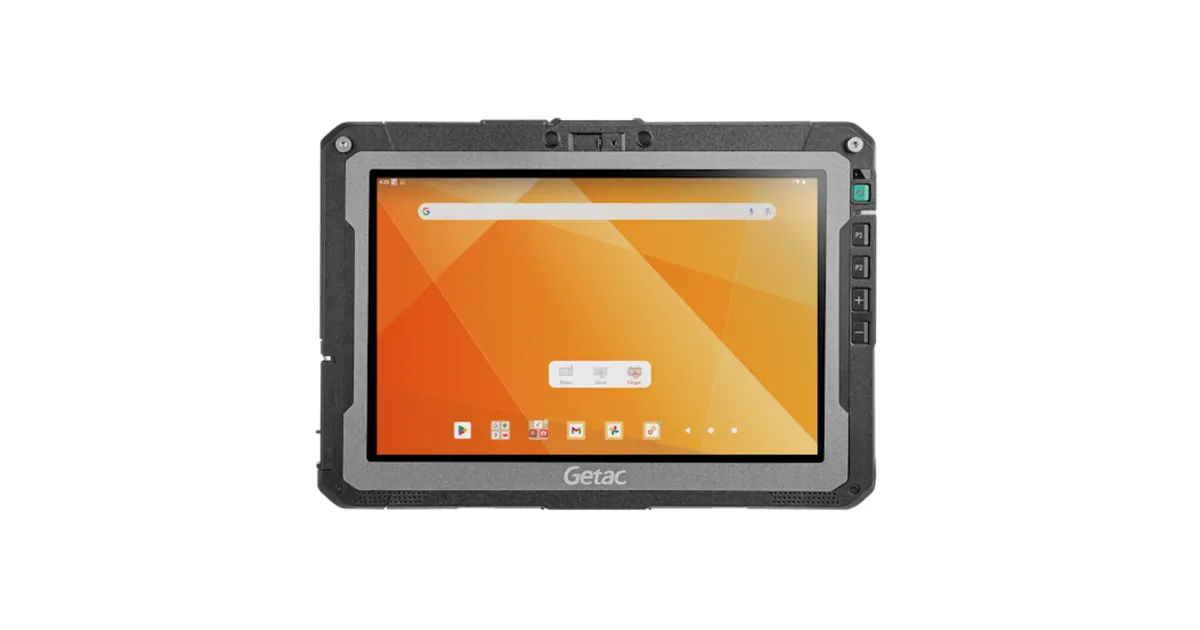
Image: Getac ZX10 G2, RobustBook product photo
What Zebra writes about the ET51 and ET56
The ET51 and ET56 are Zebra tablets with 8.4 and 10.1 inches. The ET56 also has cellular and GPS. Zebra lists them as Android and as Windows versions. The Android datasheet page states:
- Display: 8.4 inches with 720 nits or 10.1 inches with 540 nits, resolution up to 2560 x 1600, Corning Gorilla Glass.
- Touch: capacitive with ten touch points, operable with a finger, with a glove and with a passive stylus. The page lists no digitizer or active pen.
- System: Qualcomm Snapdragon 660 with eight cores and 2.2 GHz, Android, upgradeable to Android 14.
- Protection: IP65, drop from 1 m onto concrete per MIL-STD-810G, 1.8 m with the optional rugged frame, operation from -20 °C to 50 °C.
- Battery: 6440 mAh (24.4 Wh) in the 8.4-inch model and 9660 mAh (37.1 Wh) in the 10.1-inch model, both user-replaceable. A hot-swappable secondary battery with 3400 mAh is optional.
- Weight: 514 g for the ET51 with 8.4 inches, 527 g for the ET56 with 8.4 inches and 745.5 g for the ET51 with 10.1 inches.
- Wireless: WLAN to 802.11ac, Bluetooth 5.0. Only the ET56 has LTE (data only) and GPS.
- Warranty: one year from shipment.
Instead of Android, the Windows page lists an Intel Atom A3940 with Windows 10 IoT Enterprise, Bluetooth 4.2 and weights of 570 g (8.4 inches) and 765 g (10.1 inches). Protection rating, drop figure and temperature range match the Android page.
Sales status and support according to Zebra
On the support pages for the ET51 and ET56, Zebra writes that the product is no longer offered for sale. For the Android version, Zebra gives 31 March 2025 as the last sales date and 31 March 2029 as the end of service and support. For the Windows version, the dates are 29 December 2023 and 24 October 2028.
As replacements, Zebra names on the same pages the ET60W and ET65W for Windows, the ET40 and ET45 for Android and the ET60 for rugged Android. The ET65 is not named there. According to Zebra's datasheet page, it is the version of the ET60 with cellular. The datasheet pages for the ET51 and ET56 do not carry the sales notice. It appears only on the support pages.
ET60 and ET65: data according to Zebra
The ET60 and ET65 are Android tablets with 10.1 inches. Only the ET65 has cellular (5G, data only). The datasheet page states:
- Display: 10.1 inches WUXGA (1920 x 1200) with 1000 nits, optically bonded to the touch panel, Gorilla Glass. The touchscreen works with a bare or gloved finger and with a conductive stylus sold separately.
- System: Qualcomm 6490 with eight cores and 2.7 GHz, Android up to Android 16.
- Battery: standard 8920 mAh, extended 17840 mAh, and in hot-swap operation a supercapacitor bridges about five minutes.
- Protection: IP66, drop from 1.5 m onto concrete, operation from -20 °C to 55 °C with the standard battery and from -30 °C to 55 °C with the extended battery. The page also lists Class 1 Division 2.
- Weight: 1108 g with the standard battery, 1247 g with the extended battery.
- Wireless: Wi-Fi 6E and Bluetooth 5.2.
- Warranty: three years from shipment.
Zebra writes that the ET60 and ET65 are sold for four years from first release and that service runs for a further four years. The ET60 product page also says "Replaces XSLATE L10 Android, XPAD L10 Android". The Windows counterpart ET60W/ET65W also has 10.1 inches and 1000 nits, plus Windows 11, Intel Core Ultra, Wi-Fi 7, Bluetooth 5.4, IP66, an operating range of -29 °C to 63 °C and 1248 g. For the pen, Zebra lists a passive stylus in the box there and compatibility with MPP 2.0 pens. What a digitizer is and how pens differ is explained in the article Digitizer and pen on a rugged tablet.
What changes from ET5x to ET6x
Zebra compares the Android models in a separate comparison sheet. The table gives its values and those of the datasheet pages.
| Feature | ET51/ET56 Android | ET60/ET65 |
|---|---|---|
| Display | 8.4 inches (720 nits) or 10.1 inches (540 nits) | 10.1 inches (1000 nits) |
| Processor | Qualcomm Snapdragon 660, 2.2 GHz | Qualcomm 6490, 2.7 GHz |
| Android | upgradeable to Android 14 | up to Android 16 |
| WLAN | Wi-Fi 5 | Wi-Fi 6E |
| Cellular | LTE (ET56 only) | 5G (ET65 only) |
| Protection rating | IP65 | IP66 |
| Drop onto concrete | 1 m, 1.8 m with rugged frame | 1.5 m without rugged frame |
| Operating temperature | -20 °C to 50 °C | -20 °C to 55 °C, -30 °C to 55 °C with extended battery |
| Weight, 10.1 inches | 745.5 g (ET51) | 1108 g (standard battery) |
| Warranty | 1 year | 3 years |
At 1108 g, the ET60 weighs around 360 g more than the ET51 with 10.1 inches. The ET60 page names no model with 8.4 or 8 inches. Anyone replacing a small ET51 finds the ET40 and the ET45 on the support page as the Android replacement.
What a replacement has to offer
The Zebra pages show the points on which a switch depends:
- Operating system and size: Zebra lists the ET51 separately as an Android and a Windows version, with 8.4 or 10.1 inches. The choice fixes software and form factor.
- Scanner: on the ET51 the SE4750 imager comes via the expansion back, on the ET60 an integrated SE55 is optional.
- Battery: on the ET51 the user replaces the battery, and a secondary battery needs the expansion back. Our datasheets list tool-free replaceable or hot-swappable batteries depending on the model.
- Pen: according to Zebra, the ET51 works with a passive pen. If you need a digitizer, look at the datasheets of the alternatives.
- Accessories: docks, mounts and rugged frames belong to the device. Expect new accessories when you change manufacturer.
Six tablets from our range next to the ET51 and ET60
The table shows core data from our datasheets. The top two rows give the Zebra values. The watt-hours are calculated as voltage times capacity and apply per battery. A runtime cannot be derived from them.
| Model | Display | Brightness | Protection and test standard | Weight | Battery | Operating temperature |
|---|---|---|---|---|---|---|
| Zebra ET51, 10.1 inches (manufacturer data) | up to 2560 x 1600 | 540 nits | IP65, MIL-STD-810G | 745.5 g | 9660 mAh, 37.1 Wh | -20 °C to 50 °C |
| Zebra ET60 (manufacturer data) | 1920 x 1200 | 1000 nits | IP66, MIL-STD-810H | 1108 g | 8920 mAh | -20 °C to 55 °C |
| Getac ZX80 (Android 15.0) | 8 inches, 1920 x 1200 | 1000 nits | IP67, MIL-STD-810H | 590 g | 4060 mAh at 3.86 V (about 15.7 Wh), options up to 9980 mAh | -29 °C to 63 °C |
| Fieldbook N80G2 (Android 12) | 8 inches, 1280 x 800 | 500 nits | IP67, no MIL-STD stated | 600 g | 8000 mAh at 3.6 V (about 28.8 Wh), tool-free replaceable | -20 °C to 60 °C |
| Getac ZX10 G2 (Android 15.0) | 10.1 inches, 1920 x 1200 | 1000 nits | IP66, MIL-STD-810H | 906 g | 4990 mAh at 3.88 V (about 19.4 Wh), optional 9980 mAh | -29 °C to 63 °C |
| Fieldbook N101G2 (Android 14) | 10.1 inches, 1200 x 1920 | 700 nits | IP65, MIL-STD-810H | 1.14 kg | 10000 mAh at 3.8 V (about 38 Wh), tool-free replaceable | -20 °C to 60 °C |
| Fieldbook P101 (Windows 11 Pro) | 10.1 inches, 1920 x 1200 | 700 nits | IP65, MIL-STD-810G | 1.14 kg | 5000 mAh at 7.4 V (37 Wh), hot-swappable | -20 °C to 60 °C |
| RuggON PX501 G5 (Windows 11 GAC optional) | 10.1 inches, 1920 x 1200 | 1000 nits | IP65, MIL-STD-810H, MIL-STD-461G | 1.36 kg | 4500 mAh at 10.8 V (48.6 Wh), hot-swappable, optional 9000 mAh | -20 °C to 60 °C |
In display, the Getac ZX10 G2, the Fieldbook P101 and the RuggON PX501 G5 with 10.1 inches and 1920 x 1200 pixels are at the level of the ET60. The ZX10 G2 and the PX501 G5 reach the 1000 nits of the ET60, while the P101 has 700 nits and is thus above the 540 nits of the ET51. In protection rating, the ZX10 G2 with IP66 equals the ET60. The ZX80 and N80G2 have IP67, which is more than the ET51 with IP65.
In weight, the ZX10 G2 weighs 906 g, which is 202 g less than the ET60 and around 160 g more than the ET51 with 10.1 inches. At 590 g, the ZX80 is 76 g above the ET51 with 8.4 inches. The operating range of -29 °C to 63 °C on the ZX80 and ZX10 G2 extends further than the Zebra figures at both ends. On wireless, the datasheets list Wi-Fi 6E and Bluetooth 5.2 for the ZX80 and ZX10 G2, Wi-Fi 5 and Bluetooth 5 for the N80G2, as on the ET51, and Wi-Fi 6 for the N101G2. The ZX80 and ZX10 G2 list optional 5G Sub-6. Our datasheets say nothing on private 5G or CBRS.
On scanners, the N101G2 datasheet names a Zebra SE4710 reader as an option, the ZX80 datasheet an optional 1D/2D imager and the P101 datasheet an optional laser scanner. None of the six datasheets names an attachable keyboard.
When Zebra remains the better choice
If your operator requires Class 1 Division 2, Zebra lists this rating for the ET60. Our Ex tablets Getac ZX80 EX and UX10 EX are certified to ATEX/IECEx Zone 2/22, and the datasheets name no class and division rating. What the zones mean is explained in the article on ATEX and explosion protection in devices. The case is similar for a Zebra fleet with docks, mounts and device management. There, a switch costs more than the single tablet. And anyone running a private 5G network finds it named explicitly for the ET60/ET65 and not for our tablets.
Support also remains open. Zebra names LifeGuard for security updates and a three-year warranty for the ET60. On update commitments for our Android tablets, the datasheets say nothing. Ask about that before you decide, and read the article Windows or Android on the rugged tablet as well.
Frequently asked questions
Is the Zebra ET51 or ET56 still sold?
No. Zebra writes on its support pages that the product is no longer offered for sale. The last sales date of the Android version was 31 March 2025, and of the Windows version 29 December 2023. Service and support end on 31 March 2029 and on 24 October 2028 respectively.
Which Zebra tablet does Zebra name as the replacement for the ET51?
The ET60W and ET65W for Windows, the ET40 and ET45 for Android, the ET60 for rugged Android. Which one fits depends on operating system, size and use.
Is there an ET60 with 8 inches?
The datasheet page for the ET60 and ET65 shows only a display with 10.1 inches. For smaller devices, Zebra names the ET40 and ET45 on the ET51 support page.
Which of your tablets comes closest to the ET60?
In display, brightness and WLAN, the Getac ZX10 G2 with Android 15.0, IP66 and 1000 nits, and for Windows the RuggON PX501 G5. The ZX10 G2 weighs 906 g and the ET60 1108 g, and the ZX10 G2 works up to 63 °C and the ET60 according to Zebra up to 55 °C.
Does RobustBook sell Zebra devices?
No. Our range consists of Getac, Durabook, Fieldbook, RuggON and Archos. The Zebra information in this article comes from zebra.com.
Conclusion: who should switch and who should stay
Anyone replacing an Android ET51 or ET56 with 10.1 inches compares the ET60 or ET65 with the Getac ZX10 G2 and the Fieldbook N101G2. Anyone who needs 8 inches looks at the Getac ZX80 with IP67 and 590 g or the Fieldbook N80G2 with 500 nits. Anyone replacing the Windows ET51 compares the Fieldbook P101 and the RuggON PX501 G5. Businesses that need Class 1 Division 2 or private 5G, or that keep using Zebra accessories, should stay with Zebra. No table settles whether your application runs on the target system, how long security updates will come and whether docks and mounts fit. You check that best with a device in your hand.
The RobustBook team helps with the selection and names the configuration that suits your use.