Anyone who wants to buy a used Getac, an outdoor laptop or an outdoor tablet usually receives photos and a configuration list from the seller, but rarely any information on support and warranty. This article lists the checks for which manufacturer information exists, and says openly where only the device itself can answer. It covers five points: operating system and processor, security updates and firmware, battery, warranty and the condition of the housing. All statements about Windows come from Microsoft, and all statements about warranty and support come from the manufacturers' documents.
Windows 10, Windows 11 and the processor
Microsoft ended support for Windows 10 on 14 October 2025. Since then there has been no technical assistance, no feature updates and no security updates, except for PCs enrolled in the paid ESU programme (Extended Security Updates). For businesses, ESU runs as an annual subscription for three years at most and requires Windows 10 version 22H2. Windows 10 PCs keep working without ESU, Microsoft writes. A used device with Windows 10 is therefore a case for the upgrade to Windows 11 or for ESU. The article Windows 10: first ESU year ends describes dates and conditions, and the article Windows 11 IoT Enterprise LTSC for rugged devices covers the special case of Windows 10 IoT Enterprise LTSC.
For Windows 11, Microsoft lists these minimum values: a compatible 64-bit processor with at least two cores and 1 GHz, 4 GB of memory, 64 GB of free storage, UEFI with Secure Boot, TPM 2.0, DirectX 12 graphics with a WDDM 2.0 driver, and a display of at least 9 inches diagonal and 720p. With used rugged devices, two points usually decide: the processor and the display size. Microsoft's list of supported Intel processors for Windows 11 25H2 starts at the 8th generation of Core processors and does not list 7th-generation Core processors. A tablet with an 8-inch diagonal falls below the display requirement of 9 inches.
You can check whether a particular device gets Windows 11 with Microsoft's PC Health Check program. Microsoft also writes that you can ask the device manufacturer to confirm which Windows is available on a device. Give the manufacturer the model number and the serial number.
Security updates and firmware: what Getac commits to
In its Security Support Policy, Getac writes that it strives to provide security updates for Windows devices for as long as the model is available for sale, and for three years beyond the last order date (End of Sale). The policy does not cover updates for third-party software. The policy's table gives fixed dates for individual models: for the X500 G3, sales ended on 15 September 2023 and security support on 15 October 2026. For the F110 G5, sales ended on 28 February 2023 and security support on 30 March 2026. The table lists only some models. A used device can therefore still be within security support or already be past it, depending on the model. Ask for the exact model designation including generation, and read the entry on the Getac site yourself.
On firmware and spare parts, Getac's EPEAT document states at least five years of firmware updates after the end of production. It gives repair and spare parts for at least five years from the end of placement on the market, and seven years for slate tablets. Getac's service page, by contrast, counts the spare-parts period from the end of production. Depending on the page, the periods therefore start at different points in time. What counts for your model is Getac's answer.
We found no manufacturer statement on the BIOS and driver status of individual older models. Before buying, check on the manufacturer's support page whether BIOS and drivers for Windows 11 are available for the model number.
Battery: what the datasheet says and what it does not
Getac gives one year of warranty from the purchase date on batteries supplied with the product. That is what the Getac warranty terms state. For a device older than one year, this period is over. Our datasheets give a typical and a minimum capacity for Getac devices, for the S410 G5 for example 6900 mAh typical and 6600 mAh minimum. That describes the as-new condition. We found no manufacturer statement on how much capacity a battery must still have after years.
Windows generates an HTML report on battery usage over the lifetime of the system with the command powercfg /batteryreport. That is how Microsoft describes it. Ask the seller to show you the report, generate it yourself, and also measure the runtime in operation. For devices with a replaceable battery, clarify whether spare batteries are available for the model. How hot swap works is explained in the article Replaceable battery and hot swap.
Warranty: who it belongs to
Whether a manufacturer's warranty passes to a second owner is stated in the respective warranty text. Two examples show how different this can be.
The US version of the Getac five-year warranty counts the term from the date of purchase by the original end-user purchaser, and without valid proof of purchase from the date Getac shipped the device. It applies only to products sold by Getac or an authorized dealer, and only for service by an authorized service provider. According to the text, it lapses if the Getac serial number has been removed or defaced. The text contains no rule on transfer to a later owner. In its North American warranty terms, Panasonic states explicitly that the warranty applies only to the original purchaser and cannot be transferred.
The versions differ by region and model. For a particular device, the text that belongs to the model and region applies. Ask the seller in writing whether and for how long manufacturer warranty remains, and ask the manufacturer with the serial number.
What distinguishes a used device from a new one
Objectively, a used device differs in three points. Processor, battery and warranty status belong to its year of manufacture. On top of that come signs of use that no datasheet describes. Whether that matters depends on the use. The table shows five devices from our range with the datasheet values for processor, battery and TPM. It is a yardstick: if a seller names other values, you know what to ask about.
| Device | Processor according to datasheet | Battery according to datasheet | TPM |
|---|---|---|---|
| Getac X600 | Intel Core i5-11500HE vPro (11th generation), optionally i7-11850HE vPro or Xeon W-11865MRE vPro | two hot-swappable batteries, 10.8 V each, typ. 6900 mAh (min. 6600 mAh) | TPM 2.0 |
| Durabook S15AB | Intel Core i5-8265U or i7-8565U (8th generation) | high-capacity lithium-ion battery, up to 13 hrs runtime | TPM 2.0 |
| Getac S410 G5 | Intel Core i5-1340P (standard), optionally i5-1350P vPro, i7-1360P, i7-1370P vPro | Li-ion battery 10.8 V, typ. 6900 mAh (min. 6600 mAh), optional 2nd battery | TPM 2.0 |
| Getac B360 G3 | Intel Core Ultra 5 225H (standard) | 2 × Li-ion battery, standard 4060 mAh (min. 3857 mAh) | TPM 2.0 |
| Getac UX10 | Intel Core Ultra 5 226V (standard) | Li-ion battery 11.61 V, typ. 4070 mAh (min. 3800 mAh) | TPM 2.0 |
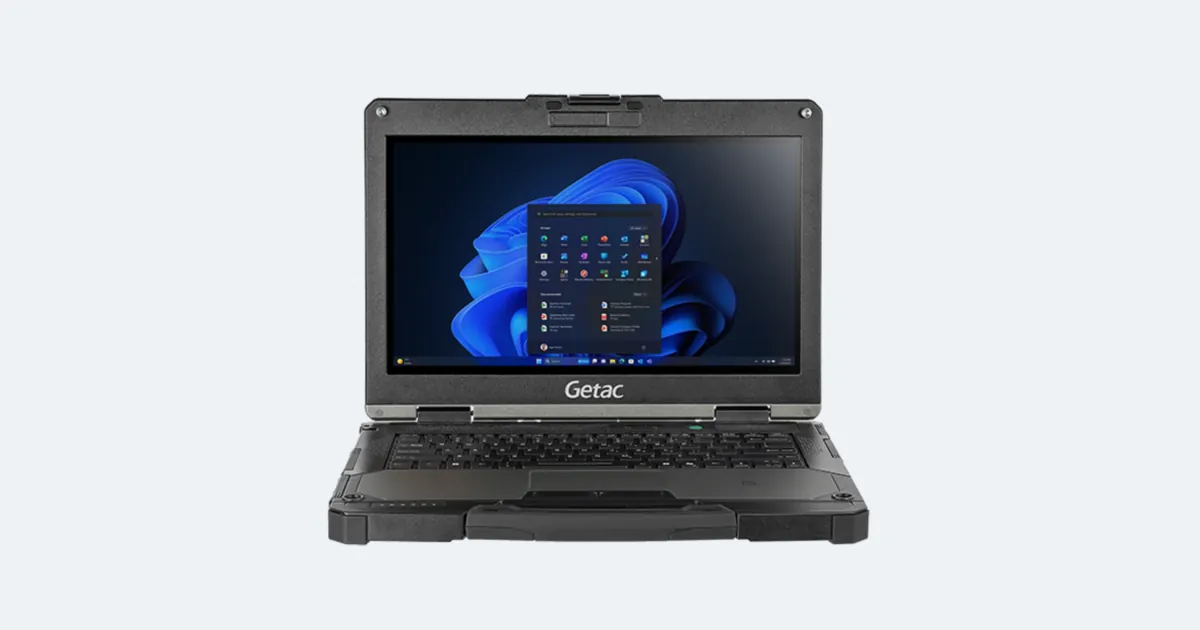
Image: product photo of the Getac B360 G3 from the RobustBook range
The row for the S15AB shows that an older processor generation can still suit Windows 11. The 8th generation is on Microsoft's list, and the datasheet gives Windows 10 Pro with the option of upgrading to Windows 11. With a device whose processor is 7th generation or older, this route is missing, because Microsoft's list does not include it. That is a reason to ask for the exact processor designation before buying.
Condition, seals and interfaces
Ratings such as IP65 or IP66 and tests to MIL-STD-810H describe the tested condition of a model, not of an individual device after years in use. Whether seals and covers perform the same in use is not stated in any manufacturer information we found. The basics of the ratings are in the article IP protection ratings. On the device itself, check:
- the rubber seals and the port covers for cracks, deformation and dirt
- the housing and corners for breaks, the display and touch on all areas, the keyboard and ports for function
- whether the serial number is legible, because without it the warranty lapses according to the Getac text
- whether the BIOS password, drive encryption and a registration in a device management system have been removed by the previous owner
- the battery report and the runtime in operation, as described above
Frequently asked questions
Does a used device with Windows 10 still get updates?
Since 14 October 2025, security updates have been available only through the paid ESU programme. If the device meets the Windows 11 requirements, the upgrade is the route Microsoft recommends.
How do I tell whether the processor is enough for Windows 11?
Read off the exact processor designation and compare the generation with Microsoft's processor list. For Intel, the list starts with the 8th generation. PC Health Check checks the device directly, and the manufacturer can confirm which Windows is available for the model.
Does the manufacturer warranty apply to a second owner?
That is stated in the manufacturer's warranty text. The Getac text names the original end user as the start of the term and does not regulate transfer, while Panasonic explicitly rules transfer out. Have the manufacturer confirm the status with the serial number.
How long are BIOS updates and spare parts available?
Getac states at least five years of firmware updates after the end of production and spare parts for at least five years, seven years for slate tablets. For other manufacturers and models, ask the manufacturer.
Conclusion: a used device suits under certain conditions
A used rugged device suits you if it gets Windows 11 or deliberately keeps running on Windows 10 with ESU, if the battery has been measured and can be replaced, and if the manufacturer still commits to firmware and spare parts for the model. It suits you less if your use requires a manufacturer warranty and the seller does not document it in writing, or if the processor is missing from Microsoft's list and Windows 10 is not meant to be an option.
What remains open is what no document answers: how far seals and battery cells have aged. Only an inspection of the device settles that. For devices with hazardous-area approval, ask the manufacturer before buying whether the approval applies to exactly this configuration. If you have questions about the selection, the RobustBook team will support you.